TwinMind ranks #19 of 28 AI meeting assistants we tested in 2026, scoring 3.4 out of 5. A fast-improving second-brain app with strong transcription and bot-free capture on phone and desktop, held back mainly by cloud-dependent AI and thin integrations. Pricing starts at $11.99/mo with a free tier available. Available on iOS, Android, Mac, Windows, Web, Chrome, Apple Watch.
TwinMind Key Facts
Checked against vendor documentation October 14, 2026- How it records
- Phone mic for in-person and all-day capture; Chrome extension, Mac and Windows apps for calls; Apple Watch; no bot
- Where AI processing runs
- Hybrid — Ear-3 transcription and all AI chat run in the cloud; on-device Ear-2 model used offline
- Works offline
- Partly — falls back to on-device transcription without a connection; AI features need the cloud
- Trains on your data
- No for transcripts and chats; de-identified audio only if you turn on Save Audio (off by default)
- Transcription languages
- 140+ (Ear-3)
- Free plan
- Unlimited capture hours and summaries; premium models are Pro-only
- Paid plans from
- $11.99/mo (Pro)
- In-person meetings
- Yes — iOS and Android apps, Apple Watch
- Real-time features
- Live transcript, real-time suggestions and translation
- Compliance
- SOC 2 Type II (vendor badge); US processing; HIPAA not stated
Compare every tool on these facts in the AI meeting assistant fact sheet, or see the best TwinMind alternatives.
Rating Breakdown
Strengths
- + Raw audio deleted after transcription by default; transcripts can stay on the device
- + Strong claimed transcription accuracy with the Ear-3 model
- + Generous free tier with unlimited transcription
- + No bot required; all-day continuous capture
- + Multi-model AI chat (ChatGPT, Claude, Gemini) over your history
Weaknesses
- – Its best transcription model (Ear-3) and all AI chat run in the cloud
- – Very limited third-party integrations
- – No self-serve team tier; enterprise is sales-led
- – Free-tier limits vary across sources
Our Verdict
A fast-improving second-brain app with strong transcription and bot-free capture on phone and desktop, held back mainly by cloud-dependent AI and thin integrations.
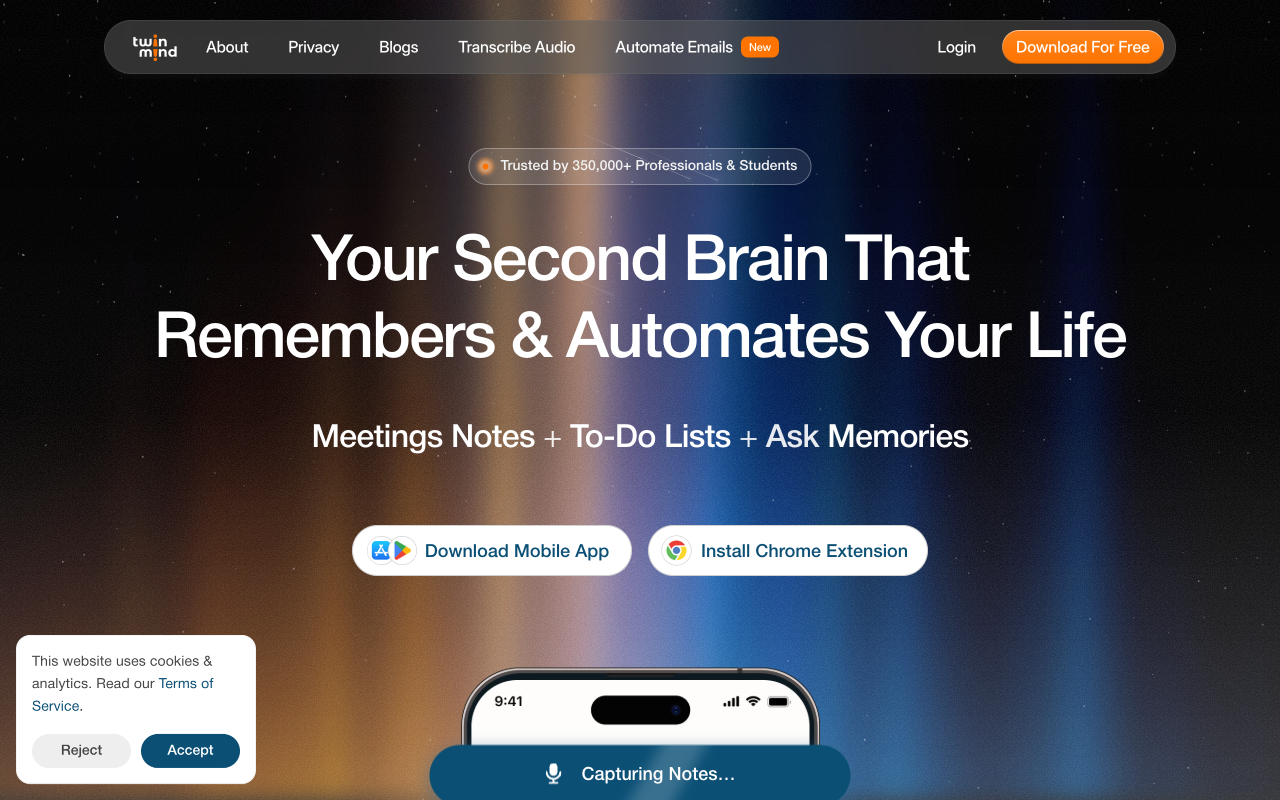
TwinMind frames itself as a “second brain” rather than a meeting recorder. Instead of treating each call as an isolated transcript, it captures your conversations all day and builds a searchable personal memory you can question in plain language. Ask it to summarize last week’s meetings or recall what a colleague committed to, and it pulls the answer from your own history. The pitch leans less on note-taking and more on remembering.
The app runs on iOS and Android as first-class native apps, with Mac and Windows apps, an Apple Watch app, a web app at app.twinmind.com, and a Chrome extension for desktop meetings. Capture happens without a bot. Processing is hybrid: TwinMind’s best transcription model runs in the cloud, an on-device model covers offline use, and the AI work like multi-model chat and memory search happens in the cloud. It supports continuous all-day capture, roughly 14 to 17 hours in a stretch depending on the source.
TwinMind is no longer the unproven curiosity it was a year ago. In September 2025 the company raised a $5.7M seed round led by Streamlined Ventures, with Sequoia Capital and Stephen Wolfram participating, at a reported valuation near $60M. The ex-Google X founding team shipped a new in-house speech model the same month, and the homepage now claims 500,000+ users. The product still has rough edges, but the trajectory is real and the transcription story in particular has flipped from a weakness to a selling point.
Key Features
The headline change is Ear-3, TwinMind’s own speech recognition model launched in September 2025. The company publishes benchmarks of roughly 5.26% word error rate and 3.8% speaker diarization error rate, with speaker labeling and support for 140+ languages. Those are vendor-reported numbers, not independently re-run by a neutral lab, but multiple 2026 reviews cite them and the practical experience has clearly improved. Ear-3 runs in the cloud; unlike the earlier Ear-2, it does not support a fully offline experience, so the app falls back to the on-device Ear-2 model when there is no connection.
The other pillar is Ask Anything, a natural-language search across your full conversation and memory history. You can ask things like “summarize all my meetings last week” and get an answer drawn from everything TwinMind has captured. It pairs this with multi-model AI chat, letting you route questions to ChatGPT, Claude, or Gemini against your own context. This RAG-style “second brain” search is the real product, not a visualized graph diagram.
Capture works without a meeting bot, so nothing announces itself or joins your call. TwinMind handles continuous all-day capture, multilingual transcription with real-time translation across 140+ languages, and offline transcription through the on-device Ear-2 model. The mobile, desktop, watch, and web apps and the Chrome extension keep your history accessible across devices.
Pricing
The free plan is genuinely generous: unlimited capture hours and summaries, with the premium AI models reserved for paid plans. TwinMind has adjusted its free limits and run promos before, so treat the current terms as a snapshot rather than a guarantee.
The pricing page currently shows Pro at $11.99 per month and Max at $29.99 per month, both labeled as 40% off, and does not make clear whether those are monthly or annual-billing rates. Pro adds the premium models, phone-call recording, and audio upload. Max raises limits fivefold and adds MCP app integration and speaker separation, with a 7-day trial. There is no self-serve team plan, but TwinMind now sells an enterprise tier through sales with custom limits, admin controls, SOC 2 compliance, and dedicated support.
Privacy & Security
TwinMind’s privacy story is better than most cloud tools but weaker than its earlier on-device framing suggested. Its default transcription model, Ear-3, runs in the cloud, and its privacy policy lists OpenAI, Anthropic, Google, Groq, ElevenLabs, and Fireworks among the processors. On the plus side, raw audio is deleted after transcription by default, transcripts can stay only on your device if you leave Backup off, and TwinMind does not train on transcripts or chats; de-identified audio is used to improve speech recognition only if you turn on Save Audio, which is off by default. Capture happens without a bot. Ask Anything search, the multi-model chat, and Deep Memory Research all run in the cloud, so conversation data does leave the device for those features. The homepage shows a SOC 2 Type II badge; HIPAA is not addressed.
Best For
TwinMind suits people who want a personal memory layer more than a polished team note-taker: heavy meeting-goers, researchers, and individuals who attend back-to-back conversations and want to query their own history later. Bot-free, all-day capture on phone and desktop makes it a good fit for anyone who wants a personal memory without a recorder joining calls. It’s a weaker pick for workflows that need deep CRM or task-manager integrations, for anyone who needs AI processing to stay on the device, and for teams that want a self-serve team plan; enterprise admin controls are available only through sales.
How TwinMind Compares to Hedy
TwinMind and Hedy share real DNA: both capture without a meeting bot, both run on phones and desktops, and both can transcribe on the device when offline. TwinMind has closed ground fast, and its Ear-3 model plus Ask Anything memory search make it a more serious tool than it was a year ago. The honest comparison is closer than it used to be on the things they have in common.
Where Hedy pulls ahead is the depth of the on-device approach. On supported hardware, Hedy can run transcription, summaries, and real-time coaching on-device as a built-in feature, so the intelligence during a meeting doesn’t need a round trip to the cloud; TwinMind’s main transcription model runs in the cloud, its on-device model is a fallback for offline use, and its chat and memory search go through cloud models. Hedy also gives you live coaching as the conversation happens, while TwinMind’s strength is retrospective recall after the fact. On platforms the two are now close, with both covering Mac, Windows, iOS, and Android. For someone who wants end-to-end on-device AI and coaching in the moment, Hedy remains the more complete pick; for a phone-first personal memory you can interrogate later, TwinMind has become a legitimate option.