Plaud.ai ranks #21 of 28 AI meeting assistants we tested in 2026, scoring 3.4 out of 5. Once an in-person-only recorder, Plaud has grown into a capable hardware-plus-software platform with a desktop app, an AI agent, and a Team plan, though its AI still runs in the cloud. Pricing starts at $8.33/mo with a free tier available. Available on iOS, Android, Web, Mac, Windows.
Plaud.ai Key Facts
Checked against vendor documentation October 14, 2026- How it records
- Hardware recorders (Note, NotePin, NotePin S, Note Pro); desktop app records calls via system audio, no bot
- Where AI processing runs
- Cloud — audio is captured on the device, then transcribed and analyzed in Plaud's cloud
- Works offline
- Partly — devices record offline; transcription and AI need the cloud
- Trains on your data
- No — user data is not used for training unless you opt in
- Transcription languages
- 112
- Free plan
- Starter: 300 minutes a month, requires an activated Plaud device
- Paid plans from
- $8.33/mo billed annually ($17.99 monthly); hardware $159–$189
- In-person meetings
- Yes — dedicated recorders, including phone-call capture
- Real-time features
- None documented — notes after recording
- Compliance
- SOC 2 Type II; ISO 27001 and 27701; HIPAA; GDPR; EU (Frankfurt) data center available
Compare every tool on these facts in the AI meeting assistant fact sheet, or see the best Plaud.ai alternatives.
Rating Breakdown
Strengths
- + Dedicated hardware records reliably in any setting
- + Desktop app now captures virtual calls with no bot
- + Free Starter tier and a clear subscription ladder
- + Plaud Agent, MCP connectors, and an API for power users
- + Broad compliance: SOC 2 Type II, ISO 27001/27701, HIPAA, GDPR
Weaknesses
- – Hardware carries an upfront cost on top of any subscription
- – Transcription and AI processing happen in the cloud
- – Real-time intelligence during a meeting is still limited
- – Best AI features sit behind the paid tiers
- – Free plan and desktop app require owning a Plaud device
Our Verdict
Once an in-person-only recorder, Plaud has grown into a capable hardware-plus-software platform with a desktop app, an AI agent, and a Team plan, though its AI still runs in the cloud.
Plaud.ai started with a simple bet: give people a dedicated piece of hardware instead of yet another meeting bot. The Plaud Note is a slim, card-sized recorder that captures audio anywhere a conversation happens, from conference rooms to coffee shops to phone calls. That hardware-first idea still anchors the brand, but the product around it has changed a lot. By mid-2026 Plaud sells four devices, runs a full subscription ladder, ships a desktop app that records virtual calls, and offers a Team plan for businesses. In August 2026 it also announced Plaud One, AI earbuds with an eSIM charging case, at $249 on preorder and shipping in Q4 2026.
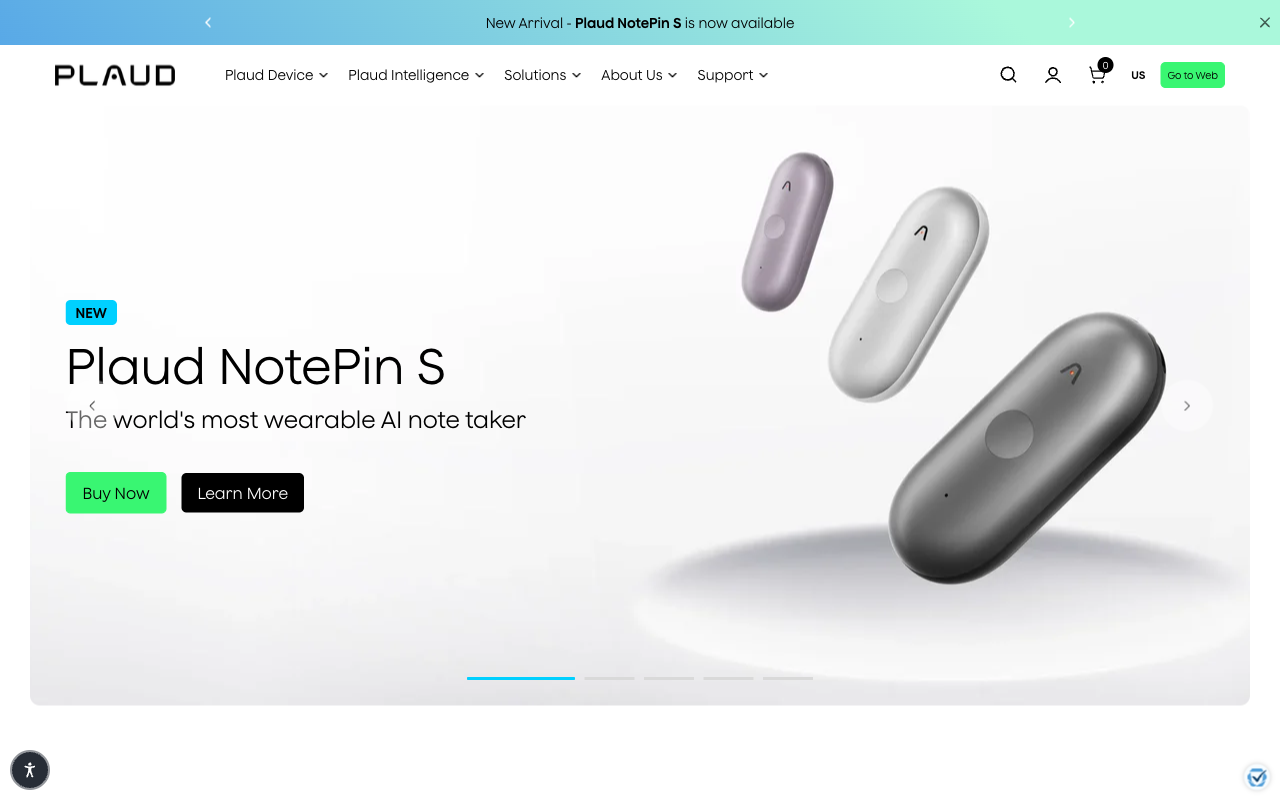
The hardware lineup now spans the Plaud Note and NotePin at $159, the NotePin S at $179, and the flagship Note Pro at $189. The Note is about the size of a credit card and attaches magnetically to the back of a phone. For phone calls it captures both sides of the conversation through vibration sensing when attached to the handset. In an in-person meeting it sits on the table and records through built-in mics. There’s no bot to manage and no meeting platform to depend on. You press a button and it records.
What changed most is the software. After recording, audio syncs to the Plaud app on iOS, Android, web, and now native desktop apps for macOS and Windows. The app transcribes the audio and runs AI on top of it, generating summaries, mind maps, and action items across more than 110 languages, with a library of over 10,000 templates to shape the output. Plaud also added Ask Plaud, a natural-language query layer over your recording history, which in September 2026 grew into Plaud Agent. The company is bootstrapped and grew fast: TechCrunch reported in August 2026 that it hit $100 million in annual run-rate revenue in June 2026, with over 2.5 million users.
Key Features
The Plaud devices record long stretches of audio in a pocketable form factor and work in any setting without software or a meeting platform. The big 2026 addition is the Plaud Desktop app for Mac and Windows, which captures virtual meetings on Zoom, Teams, Google Meet, Webex, and Slack directly from system audio, with no bot joining the call. It offers automatic, prompted, and manual recording modes, plus multimodal capture that combines audio with screen captures and highlighted moments. The desktop app is free at every tier, including Starter, but like Starter it requires an activated Plaud device.
Beyond capture, the app generates summaries, action items, and mind maps from templates. Plaud Agent, which replaced Ask Plaud in September 2026, answers questions across your recordings and now adds Artifacts (PDF, PowerPoint, Word, HTML, and Markdown documents), Skills, and Routines (the renamed AutoFlow). Since October 2026, agent tasks draw on Plaud Credits; transcription and standard summaries do not. For developers and power users, Plaud ships an MCP server, one-click MCP connectors for Claude and ChatGPT (July 2026), a CLI, and a developer API. Connectors for Slack, Notion, Google Calendar, Linear, and Zapier arrived in September 2026, and Team accounts in the US got a Salesforce integration.
Pricing
Hardware is a one-time purchase, from $159 for the Plaud Note or NotePin up to $189 for the Note Pro. Software is billed separately and follows a clear ladder. The free Starter plan includes 300 transcription minutes a month and does not expire, though it needs an activated Plaud device. Pro is $99.99 a year (about $8.33 a month on annual billing, or $17.99 month-to-month) and lifts the cap to 1,200 minutes a month. Unlimited is $239.99 a year (about $19.99 a month annual, $29.99 monthly) with up to 24 hours a day of transcription. The Plaud Desktop app is included free at every tier, for device owners.
For organizations, the Team plan launched in July 2026. Under an offer that ends November 30, 2026, it costs $20 per user per month on annual billing for the first year (then $25) or $28 monthly (then $35). Because the hardware cost is upfront and the recording itself carries no recurring fee, Plaud appeals to people who dislike subscription fatigue, though the honest comparison is total cost of ownership: device plus whatever software tier you need, weighed against a pure software alternative.
Privacy & Security
Plaud’s privacy model still has two phases. During recording, audio is captured and stored locally on the device, with no cloud connection required, which is a strong posture for the capture step. Once audio syncs to the app for transcription and AI processing, it goes to cloud servers, so the analysis stage carries the same cloud exposure as any other cloud transcription tool. The local capture remains a real advantage where network monitoring is a concern, but the end-to-end story is mixed.
The compliance picture is stronger than the architecture suggests. Plaud’s Trust Center lists SOC 2 Type II, ISO 27001, ISO 27701, HIPAA, GDPR, and EN 18031, apparently company-wide rather than only on business plans, with data centers in the US, Frankfurt, Japan, and Singapore. Plaud says it does not train on user data unless you opt in, and that the LLMs it uses (GPT, Claude, Gemini) run under zero-data-retention contracts. The Team plan adds centralized billing and user management. That makes Plaud a more credible option for healthcare, legal, and other compliance-sensitive workflows than it was a year ago, though Plaud does not publish which plan includes a signed BAA.
Best For
Plaud suits professionals who need dependable audio capture across both physical and virtual settings. Lawyers recording client meetings, consultants on site, journalists running interviews, and executives in boardrooms get hardware reliability and unique phone-call recording. With the desktop app, remote and hybrid workers who live in Zoom and Teams now get bot-free capture too, which puts Plaud in direct competition with software note-takers like Granola and Fathom. Regulated teams get SOC 2, ISO, and HIPAA coverage, though they should confirm BAA terms with Plaud. Where Plaud is still weaker is real-time guidance during a meeting and fully on-device processing.
How Plaud.ai Compares to Hedy
Plaud and Hedy represent two philosophies: hardware-anchored capture versus end-to-end intelligent software. Plaud’s devices guarantee recording reliability in any physical environment, and with the new desktop app it captures virtual calls without a bot, the same bot-free approach Hedy takes. So the gap on capture has narrowed. Hedy also records in-person meetings through device microphones, so neither side forces you to carry extra hardware.
The durable difference is where the AI runs. On supported hardware, Hedy can transcribe, summarize, and coach you on-device in real time, so your conversation does not have to leave your machine. Plaud captures locally but sends audio to the cloud for transcription and AI, and its in-meeting intelligence is still limited to recording rather than live guidance. Plaud has clearly closed ground on features, with Plaud Agent, MCP connectors and an API, Slack, Notion, calendar and Zapier connectors, and a Team plan. If you want a dedicated recorder for settings where a laptop or phone is impractical, or hardware you can hand to a team, Plaud earns its place. If your priority is real-time coaching and keeping the whole pipeline private and on-device, Hedy is the stronger fit.