Outdoo ranks #28 of 28 AI meeting assistants we tested in 2026, scoring 3.0 out of 5. A specialized AI sales roleplay and revenue-intelligence platform that earns its strong reputation with sales teams, but it is not a general-purpose meeting assistant. Pricing starts at Free with a free tier available. Available on Web, iOS, Android.
Outdoo Key Facts
Checked against vendor documentation October 14, 2026- How it records
- Bot joins Zoom, Meet and Teams sales calls; imports recordings from 55+ call-recording tools
- Where AI processing runs
- Cloud; private cloud option on Enterprise
- Works offline
- No — needs an internet connection
- Trains on your data
- No — states customer data is not used for AI training
- Transcription languages
- Not published by the vendor
- Free plan
- 60 minutes of AI roleplay per account, unlimited team members, call recording and analysis
- Paid plans from
- Not public — Growth and Enterprise are quote-based
- In-person meetings
- No — roleplay practice only
- Real-time features
- Post-call scorecards; live in-call assistance not documented
- Compliance
- SOC 2 Type II; HIPAA, GDPR and CCPA claimed; SSO, PII scrubbing and audit logs on Enterprise
Compare every tool on these facts in the AI meeting assistant fact sheet, or see the best Outdoo alternatives.
Rating Breakdown
Strengths
- + AI sales roleplay in voice, chat, and video with multi-persona simulations
- + Call scoring and coaching analytics tied to real recordings
- + Free tier on both the AI Roleplay and Revenue Intelligence product lines
- + Deep CRM and revenue-intelligence integrations for sales orgs
Weaknesses
- – Built for sales workflows, not general-purpose meeting notes
- – Growth and Enterprise tiers are custom-quoted with no public pricing
- – Free roleplay is capped at 60 minutes per account
- – Cloud-only processing
- – No desktop apps and no offline capture
Our Verdict
A specialized AI sales roleplay and revenue-intelligence platform that earns its strong reputation with sales teams, but it is not a general-purpose meeting assistant.
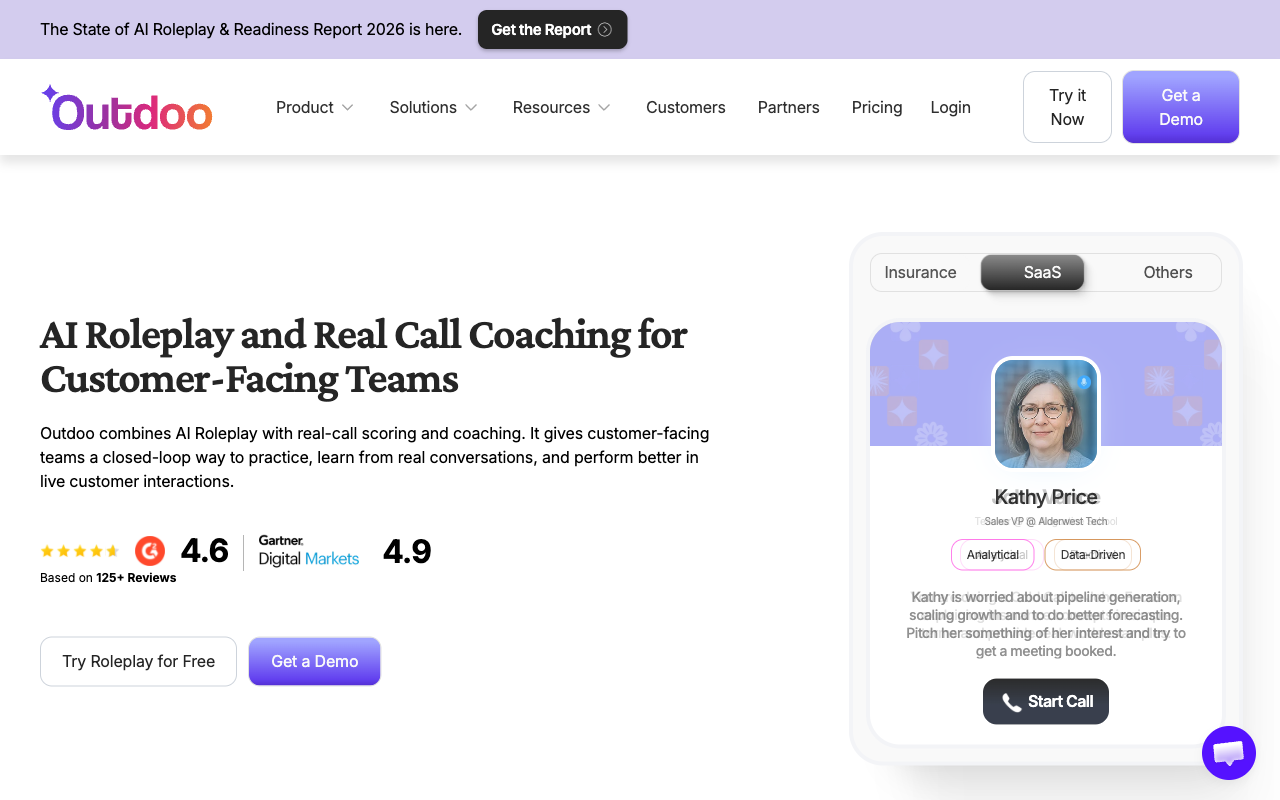
Outdoo (formerly MeetRecord) is an AI sales roleplay, coaching, and revenue-intelligence platform, not a general-purpose meeting assistant. It competes with Gong and Chorus rather than Otter or Fireflies. In September 2025 the company rebranded from MeetRecord to Outdoo and repositioned itself from conversation intelligence into a broader revenue-performance system organized around three stages: prepare, perform, and improve. Reps practice before calls, the platform records and analyzes the calls themselves, and managers coach against what actually happened. If your team’s goal is closing more deals and sharpening sales conversations, Outdoo is built for that workflow specifically.
The platform’s most distinctive piece is its AI sales roleplay suite, which lets reps rehearse against AI buyer personas in voice, chat, and video before real conversations. The free roleplay plan ships with a library of preset agents for scenarios like cold calls and discovery, plus an AI bot builder for creating your own, though that tier is capped at 60 minutes of roleplay per account. On the revenue-intelligence side, managers get call scoring and coaching dashboards that surface coachable moments from recorded conversations, along with buyer-persona insights and objection detection. Revenue analytics tie call activity back to pipeline and deal outcomes. The narrow focus cuts both ways: Outdoo is strong for sales enablement, but it is not the tool for team standups, brainstorming sessions, or general meeting notes.
Outdoo connects to your CRM to automate data entry and surface deal-risk signals. Call recordings are analyzed for talk ratios, question patterns, and competitive mentions, and the platform generates summaries and next-step recommendations. The roleplay side has expanded into structured learning, with courses and auto-generated microlearning modules that build on a rep’s own call history. That breadth is a meaningful step beyond the basic call-recording reputation the older MeetRecord brand carried. In August 2026 Outdoo pushed further, applying roleplay scorecards to live call performance, building contextual roleplays from a team’s own calls, and adding Workflow Training for CRM steps and AI Tutors.
The company has external signals behind it, too. In May 2026 Outdoo was ranked #1 for Satisfaction in G2’s AI Sales Roleplay Tools category, drawing on what G2 described as the broadest verified feedback base in that category, with more than 105 reviews, and in G2’s Fall 2026 reports it ranked #1 for Best Results and #1 for Most Implementable in the same category. The company says more than 250 enterprises use it. Outdoo also raised a $2.7M pre-Series A in 2024, led by SWC Global with All In Capital participating, to expand its revenue-automation platform.
Key Features
The core of Outdoo is AI sales roleplay in voice, chat, and video, with multi-persona simulations and AI buyer personas. The free roleplay tier includes a set of preset agents, an AI bot builder, scoring rubrics with AI call feedback, and objection detection. On the revenue-intelligence side, automated call scoring evaluates rep performance against configurable criteria, coaching dashboards highlight coachable moments and track improvement over time, and buyer-persona insights analyze prospect engagement across calls. Roleplay courses and adaptive microlearning turn recorded calls into structured training. Revenue analytics connect call activity to deal outcomes and pipeline health, and CRM integration automates data capture while flagging deal risk. Outdoo lists 120+ integrations, including 55+ call-recording tools and 40+ learning management systems, and the Growth plan includes API and MCP access. Native iOS and Android apps extend the platform beyond the browser, and a Salesforce AppExchange listing supports tighter CRM workflows.
Pricing
Outdoo’s pricing changed materially with the rebrand. Both product lines now have a plan explicitly labeled “Free” on the official pricing page. The AI Roleplay free plan is aimed at teams assessing fit for coaching and onboarding and includes up to 60 minutes of roleplay in total per account, unlimited team members, a library of preset roleplay agents, the AI bot builder, scoring rubrics, objection detection, and 24/5 support. The Revenue Intelligence free plan targets small teams evaluating call recording, conversation intelligence, and basic coaching, and includes recording and analysis, call summaries, buyer-persona insights, and objection detection.
Above the free tiers, Growth and Enterprise are custom-quoted per seat with no public dollar figure, and annual contracts are the norm with integrations bundled into the license. A free trial or proof-of-concept is also available. Note that some aggregator listings still describe Outdoo as custom-pricing-only with no free plan; the official pricing page, which is the more recent source, shows otherwise. The practical takeaway is that there is now a genuine self-serve path to evaluate the platform before talking to sales, which was not the case under the old model.
Privacy & Security
Outdoo processes call recordings through its cloud infrastructure. Because it handles sales conversations, the data flowing through the system often includes sensitive deal details, pricing discussions, and competitive information. Outdoo’s pricing page now makes specific claims: SOC 2 Type II with third-party audits; GDPR, HIPAA, and CCPA compliance; and a statement that customer data is not used for AI training. Enterprise adds SSO (SAML/OIDC), PII scrubbing, private cloud deployment, and audit logs, and a Trust Vault holds the documentation. These are vendor claims, so regulated teams should still request the reports and confirm BAA terms before routing sales conversations through it. There is no on-device option and no offline mode; everything runs in the cloud.
Best For
Outdoo is built for sales teams and revenue organizations that want AI-driven roleplay, coaching, call scoring, and deal analytics. Sales managers scaling coaching across a growing team, revenue leaders who want pipeline visibility tied to call activity, and enablement teams standing up roleplay-based training will get the most out of it. The new free tiers also make it reasonable for a small team to trial the platform without a sales call. Outdoo is not the right fit for general meeting notes, non-sales teams, or anyone who just needs a straightforward transcription tool.
How Outdoo Compares to Hedy
Outdoo and Hedy solve different problems. Outdoo is a sales roleplay and revenue-intelligence platform; Hedy is a general-purpose meeting assistant. Outdoo’s strengths are rep practice, call scoring, coaching, and CRM-tied deal analytics for sales orgs. Hedy provides real-time coaching, transcription, and structured analysis for any conversation, sales or not.
The durable difference is where the AI runs. On supported hardware, Hedy’s transcription, summaries, and real-time coaching can all run on-device, and it captures conversations without sending a bot into the meeting. Outdoo records and processes everything in the cloud and is built around recorded sales calls. Both now offer mobile apps, so the old “web-only” framing for Outdoo no longer holds, but Outdoo still has no desktop apps and no offline capability, while Hedy runs on Mac, Windows, iOS, Android, and web and works offline. For a sales organization that wants AI roleplay and revenue intelligence as a dedicated system, Outdoo is purpose-built for that and well regarded for it. For private, on-device meeting intelligence across every kind of conversation, including the meetings that happen outside the sales pipeline, Hedy is the more versatile choice.