Fireflies.ai ranks #6 of 28 AI meeting assistants we tested in 2026, scoring 3.8 out of 5. Best for sales teams who need deep CRM integration and conversation analytics, now with real-time meeting features layered on top. Pricing starts at $10/mo with a free tier available. Available on Web, Chrome, Mac, Windows, iOS, Android.
Fireflies.ai Key Facts
Checked against vendor documentation October 14, 2026- How it records
- Meeting bot by default; bot-free Chrome extension for Google Meet; bot-free desktop app; mobile app
- Where AI processing runs
- Cloud — transcription and AI run on Fireflies' servers
- Works offline
- No — needs an internet connection
- Trains on your data
- No — states it does not train on meeting content; zero data retention at its AI vendors
- Transcription languages
- 100+ (English, Spanish, French, Portuguese and Italian primary; the rest in beta)
- Free plan
- Limited transcription, 400 minutes of storage per team, 2-hour recording limit, 20 one-time AI credits
- Paid plans from
- $10/mo per seat billed annually ($18 monthly)
- In-person meetings
- Yes — mobile app
- Real-time features
- Live transcription, real-time notes and AskFred during the meeting
- Compliance
- SOC 2 Type II; GDPR; HIPAA on Enterprise
Compare every tool on these facts in the AI meeting assistant fact sheet, or see the best Fireflies.ai alternatives.
Rating Breakdown
Strengths
- + Excellent CRM integrations
- + Strong conversation analytics
- + Good search across meetings
- + Real-time features now built in (live notes, voice-activated web search)
Weaknesses
- – Cloud-only processing
- – Bot joins calls by default (bot-free options exist for Google Meet and the desktop app)
- – Named in Illinois biometric privacy (BIPA) litigation; a motion to dismiss is pending
- – Advanced AI features metered by a credit system on top of seat pricing
- – Can be expensive at scale
Our Verdict
Best for sales teams who need deep CRM integration and conversation analytics, now with real-time meeting features layered on top.
Fireflies.ai has carved out a strong position in the AI meeting assistant space by focusing heavily on what happens after the meeting. While transcription is table stakes, Fireflies distinguishes itself through deep integrations with CRM platforms, project management tools, and communication channels. The idea is that meeting intelligence should flow automatically into the systems your team already uses, and Fireflies executes this vision well. More recently the company has pushed into the meeting itself, adding live notes and a voice-activated web search, so the “after the meeting” framing no longer tells the whole story.
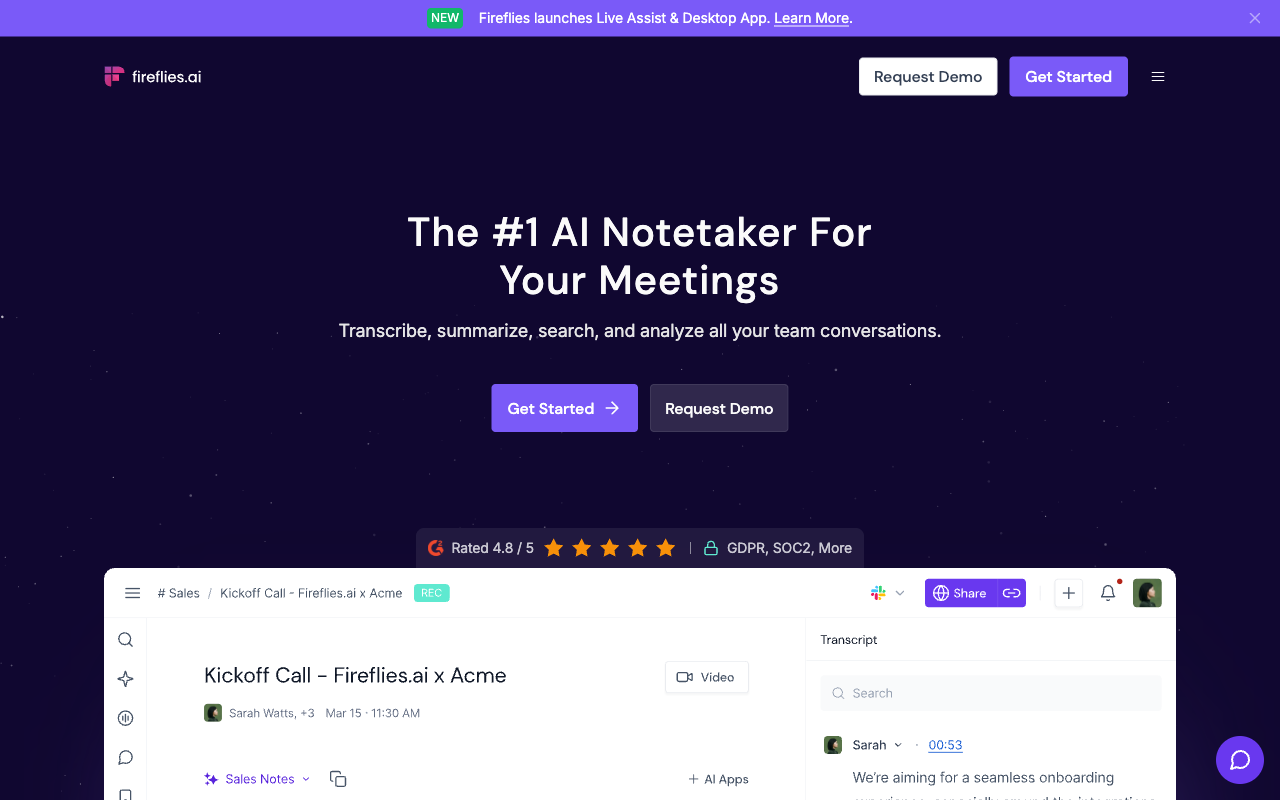
By default the platform works through a bot named Fred that joins your meetings on Zoom, Google Meet, Microsoft Teams, and other platforms. Fireflies now also offers bot-free capture: its Chrome extension can record Google Meet without Fred on every plan, and the desktop app advertises “Botless Meetings.” Either way, Fireflies records, transcribes, and then runs the conversation through Fireflies’ AI engine to extract summaries, action items, sentiment analysis, and topic tracking. The conversation intelligence features are particularly strong: you can search across all your meetings, track how much time is spent on specific topics, and analyze talk-to-listen ratios.
For sales organizations, Fireflies is especially compelling. The platform can automatically log meeting notes to Salesforce, HubSpot, and other CRMs, track deal-related conversations, and provide analytics on sales call performance. This automation eliminates hours of manual CRM data entry and ensures that important customer conversations are captured systematically. In June 2025 the company crossed a $1 billion valuation through a secondary tender offer, reporting more than 20 million users and adoption across a large share of the Fortune 500 — a sign that the bet on integrated meeting intelligence has paid off commercially.
Key Features
Fireflies offers automated meeting transcription with speaker identification across major meeting platforms, with broad multi-language support. The AskFred AI chatbot lets you query your meeting history in natural language. Conversation intelligence features include sentiment analysis, topic detection, talk time metrics, and custom trackers for specific keywords or phrases.
The 2025 product cycle added a real-time layer that the tool previously lacked. Talk to Fireflies, built on a partnership with Perplexity, lets you trigger a live web search inside a meeting by saying “Hey Fireflies” or typing “/ff” in Zoom, Google Meet, or Teams; it works across 60-plus languages and is available even on the free plan. Voice Agents are AI agents that can autonomously run or attend one-on-one calls in 70-plus languages, with configurable voice, accent, and tone. On top of these, Fireflies has expanded its library of role-specific AI apps and “Super Summaries” formats (outlines, keywords, bullet notes, overviews), plus AI Skills that apply sales frameworks like BANT and MEDDIC, Sales Assist suggestions, and CRM autofill.
The integration ecosystem remains among the best in the category, with native connections to Salesforce, HubSpot, Slack, Notion, Asana, Trello, and dozens more. Automated workflows can push meeting data to multiple destinations at once, and channels let you organize meetings by team, project, or client.
Pricing
Fireflies offers a permanent free plan, though transcription is limited (unlimited starts at Pro), storage is capped at 400 minutes per team, recordings are limited to 2 hours, and AI summaries are limited. The Pro plan is $10 per seat per month billed annually ($18 month-to-month) and includes 8,000 minutes of storage per seat plus AI summaries and key integrations. The Business plan is $19 per seat per month billed annually ($29 monthly) and adds conversation intelligence, unlimited storage, video recording, multi-language mode, and priority support. Enterprise is now publicly listed at $39 per seat per month (annual only) and adds SSO and SCIM, audit logs, HIPAA compliance, private storage, custom data retention, and a rules engine.
One important wrinkle changes how you should read those numbers. Fireflies now meters its most advanced AI features through a separate AI Credits system. Each plan ships with only a small one-time grant of credits at signup (20 on Free and Pro, 30 on Business, 50 on Enterprise), not a monthly allowance, and features like Voice Agents (one credit per minute), AI Skills, Sales Assist, and CRM autofill draw the pool down. Credits are pooled across the team rather than allocated per seat, so they do not scale as you add people, and extra credits are bought in metered top-ups starting at $5 for 50. The headline seat price is genuinely low at $10 a month, but teams that lean on the agentic features should budget for credit spend on top of it.
Privacy & Security
Like most cloud-based meeting assistants, Fireflies processes all audio on its servers. Its privacy commitments state that it does not train AI models on meeting content and that its AI vendors retain zero data. The company offers SOC 2 Type II compliance, data encryption, and the ability to set data retention policies, with HIPAA compliance, private storage, and custom retention available on the Enterprise plan. Users can delete transcripts and recordings. However, the fundamental reality is that all your meeting audio passes through Fireflies’ infrastructure. For teams discussing sensitive business matters (competitive strategy, personnel decisions, legal matters), this creates an exposure point that cannot be mitigated by encryption alone. The default bot means participants see that the meeting is being recorded, which may be appropriate for sales calls but can change the dynamic in internal discussions. The bot-free options remove that visible signal, so the job of telling the room shifts to you.
Fireflies also faces biometric privacy litigation. In Fricker v. Fireflies.AI (N.D. Ill., consolidated with Martinez), plaintiffs allege the service captures voiceprints in violation of Illinois BIPA; Fireflies’ motion to dismiss was fully briefed on 26 August 2026 and discovery is stayed pending a ruling. A separate Illinois case, Cruz, was voluntarily dismissed in March 2026, and a California case has been stayed since April 2026. Our notetaker lawsuit tracker follows these cases.
One question is worth putting to the vendor in writing before an EU rollout. Article 5(1)(f) of the EU AI Act prohibits AI systems that infer a person’s emotions in the workplace from biometric data. The prohibition has applied since 2 February 2025, and the Act’s administrative fines under Article 99 have been available since 2 August 2025, reaching the higher of €35 million or 7% of worldwide annual turnover for prohibited practices. (2 August 2026 brought general applicability of the Act’s remaining obligations, not the start of the penalty regime.) The scope is narrower than the headlines suggest: the Commission’s guidelines place emotion inferred from written text outside the prohibition, which is where most transcript-based sentiment scoring sits. Inference drawn from vocal characteristics such as tone, pitch, or prosody is much closer to the line, because voice is a behavioural characteristic. Ask which method the sentiment feature actually uses, and whether it can be disabled for EU-based staff. Consent does not cure an Article 5 prohibition the way it can supply a lawful basis under GDPR.
Best For
Fireflies.ai is the strongest choice for sales-driven organizations that need their meeting intelligence tightly integrated with CRM workflows. If your team spends significant time on sales calls and you want meeting data to flow automatically into Salesforce or HubSpot, Fireflies delivers genuine value, and the new real-time and agentic features extend that further into live calls. It is less suited for teams with strict data privacy requirements or those who need on-device processing and offline capability.
How Fireflies.ai Compares to Hedy
Fireflies wins on integrations: its ecosystem of CRM and productivity tool connections is best-in-class, and Hedy’s integration library is still expanding. Fireflies has also closed part of the old gap on real-time — it now offers live AI notes and a voice-activated web search during meetings — so it is no longer a purely post-meeting tool. The deeper trade-offs remain, though. Fireflies sends all audio to the cloud and still defaults to a bot named Fred joining the call, with bot-free capture limited to its Chrome extension for Google Meet and its desktop app; Hedy captures without a bot on every platform and, with Local AI on supported hardware, runs its transcription, summaries, and real-time coaching on-device. Fireflies offers desktop and mobile apps alongside its web and Chrome extensions, but all processing stays cloud-based; Hedy runs natively on Mac, Windows, iOS, Android, and web. Fireflies has no offline capability; Hedy works fully offline with Local AI. There is also a cost dimension worth weighing: Fireflies’ advanced AI now sits behind a metered credit system, while Hedy’s on-device features are not gated by per-use credits. For sales teams embedded in CRM workflows, Fireflies may justify the privacy trade-off. For everyone else, and especially for anyone handling confidential conversations, Hedy keeps the work on your own device and out of the cloud.
Where Fireflies.ai ranks in our guides
Frequently Asked Questions
Is Fireflies.ai free? +
Does Fireflies.ai work with Zoom, Teams, and Google Meet? +
Is Fireflies.ai secure for confidential meetings? +
How much does Fireflies.ai cost? +
Related Cloud-Based Reviews
Otter.ai
3.9Real-time transcription and agentic meeting AI for teams
Fellow
3.9Privacy-forward AI meeting assistant with botless recording and an AI Chief of Staff
Circleback
3.8Meeting notes with or without a bot, unusually clean action items, and deep automation hooks